Glossary
Amount of energy used by electronic devices as they are being operated; the most energy intensive mode.
Refers to the flow rate of electrical current past a given point. The unit of measurement of electrical current produced in a circuit by one volt acting through a resistance of one ohm.
International standard that provides minimum requirements for energy efficient designs for buildings other than low-rise residential buildings. Beginning in 2010, the code required automatic shut-off controls for plug loads and lighting in many spaces.
A non-proprietary, open communications protocol used by the Building Automation industry for BACnet. It defines the services used to communicate between building automation end-devices and building control systems. It defines how data is represented on the network and the services that are used to move data from one BACnet node to another and includes messages that identify data and network nodes.
Identifies the physical layer (IP) used to transmit BACnet packets on the network.
Establishes the “before” by capturing energy use prior to implementing an energy savings measure. Also known as
base load.
The automatic centralized control of a building’s heating, ventilation and air conditioning, lighting and other systems.
Also known as a Building Management System (BMS). A BAS is a computer-based control system installed in buildings that controls and monitors the building’s mechanical and electrical equipment such as ventilation and air conditioning, lighting, power systems, fire systems, and security systems.
State of California’s code for building energy efficiency standards.
Miscellaneous electric loads found in commercial buildings. Includes both plug load and hardwired loads.
Calculation of the highest point of demand (or peak) within the billing period for commercial and industrial customers. It is based on a price per kW and is calculated using demand intervals, a short time frame (often 15 minutes) during which overall energy usage is aggregated and tracked as a total.
Charge appearing on commercial electricity bills which is based on the highest point of demand (or peak) within the billing period. This charge is in addition to usage charges.
Voluntary utility-run programs that compensate end-use customers for reducing or shifting their electricity usage during peak periods in response to time-based rates or other forms of financial incentives.
Technology implemented to reduce the consumption of energy in a building. Also known as an Energy Savings Measure (ESM) or Facilities Improvement Measure (FIM).
Energy efficiency contractors who determine the appropriate energy savings measures, oversee construction, guarantee savings and provide verification of post-installation savings. The main differentiator between ESCOs and other energy efficiency contractors is the guarantee of energy savings which is specified as part of the terms of an energy savings performance contract (ESPC).
A network gateway joins two networks using different protocols together so the devices on one network can communicate with the devices on another network. A gateway can be implemented completely in software, hardware, or in a combination of both.
Includes 120V, 240V and 277V loads such as pool pumps, indoor/outdoor lighting, hot water heaters, 20A AC units, PTAC units, commercial refrigeration equipment, exhaust fans, and air handling units.
Refers to larger 20A loads that are hardwired to a circuit and are not controlled via receptacle.
The network of physical devices, home appliances and other items embedded with electronics, software, sensors, actuators, and connectivity which enables these objects to connect and exchange data.
Unit of energy equal to 1,000 watts.
Unit of energy over time used for pricing electricity. Equal to 1,000 watt hours which is one kilowatt of power supplied continuously for one hour. Equal to the amount of electricity needed to light ten 100-watt bulbs for one hour.
Any device that draws power from the electrical system and requires electricity to do work.
The act or practice of temporarily reducing the supply of electricity to an area to avoid overloading the power generation and distribution system. End users that reduce their loads avoid penalties or receive incentives from the utility.
A technique used in demand side management to move the consumption of loads to different times when rates are less or to avoid demand charges. Commonly used with water heaters and charging carts.
M&V refers to the process for quantifying savings delivered by an Energy Conservation Measure (ECM).
Energy used by appliances and devices outside of a building’s core functions of heating, ventilation, air conditioning, lighting, water heating, and refrigeration. MEL’s include both plug loads and hardwired loads.
Device draws no power because the device is physically turned off.
The amount of time that it takes the annual savings to equal the initial investment. BERT payback calculations do not include rebates or incentives.
Also referred to as Energy Savings Performance Contracting (ESPC), is a contracting and financing method that pays for energy efficiency upgrades today by using the energy and maintenance savings generated by the upgrades over time. Typical project terms range between seven and twenty years depending upon the types of energy savings measures installed.
PICS is a structured document which asserts which specific requirements are met by a given implementation of a protocol standard.
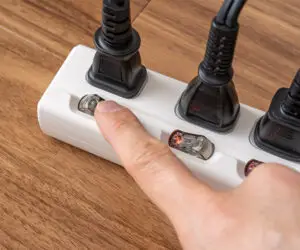
Energy used by 120V/15A products that are powered by means of an AC plug.
Plug load devices include office equipment (printers, copiers, TVs, LCD displays), break room equipment (coffee makers, vending machines, hot/cold beverage dispensers) and classroom electronics (projectors, smartboards, amplifiers, charging carts) and 15A window AC units.
A ratio between working power P (watts) and apparent power S (volt-amps). Indicates device efficiency.
A PTAC is a type of self-contained heating and air conditioning system commonly found in hotels, motels, senior housing facilities, hospitals, condominiums, apartment buildings, add-on rooms and sunrooms. Many units are designed to go through a wall, having vents and heat sinks both inside and outside.
Amount of energy used by electronic devices while they are powered on, but not in active mode. Most electronic devices never turn off completely so the device can start quickly when the user activates the device. Also known as overnight load, vampire load, phantom load, or parasitic load.
The means by which a user controls software and hardware.
The unit of measurement of electromotive force. It is equivalent to the force required to produce a current of one ampere through a resistance of one ohm. Generally measured in kilovolts or kV.
Unit of energy measuring real power production or usage equal to one Joule per second. The rate of energy transfer equivalent to 1 ampere flowing under a pressure of one volt.